Made using Grok
Socrates always presupposes the God’s existence, and under this presupposition seeks to interpenetrate nature with the idea of purpose. Soren Kierkegaard, Philosophical Fragments June 13, 1844
Scientific presuppositions are the foundational, unprovable beliefs and assumptions that must be accepted before scientific inquiry can take place. Science cannot prove its own starting assumptions. Unlike a hypothesis—which is explicitly put forward to be tested and verified through data—an assumption is taken for granted so the work can begin.
Philosophical Fragments discusses the absolute paradox—the eternal entering time, the God becoming man—through a solitary figure poised between darkness and sudden light at the edge of the sea. The shoreline and breaking dawn suggest the decisive “moment” in which the human condition is confronted with something that cannot be rationally resolved.
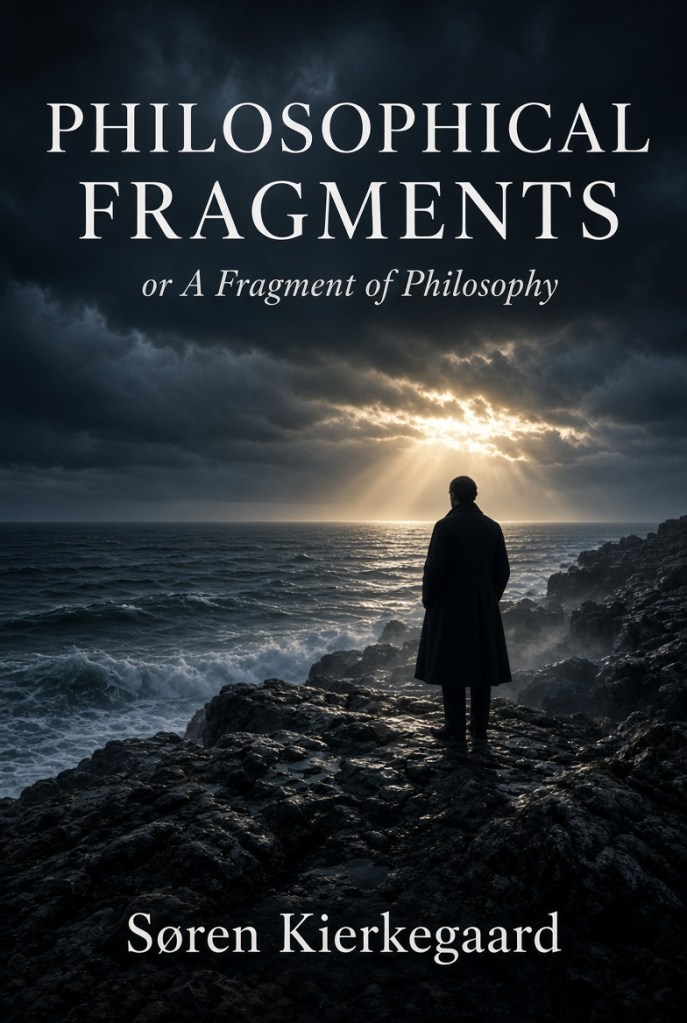
MORAL – The projected hypothesis indisputably makes an advance upon Socrates, which is apparent at every point. Whether it is therefore more true than the Socratic doctrine is an entirely different question, which cannot be decided in the same breath, since we have here assumed a new organ: Faith; a new presupposition: the consciousness of Sin; a new decision: the Moment; and a new Teacher: the God in Time. Philosophical Fragments –
Kierkegaard argues that all inquiry begins with presuppositions. Science relies on foundational assumptions that cannot themselves be scientifically proven, while faith, ethics, psychology, and dogmatics each begin from different starting points. He maintains that “every concept must be dealt with by the science to which it belongs” and that even Socrates “presupposes God’s existence” in seeking meaning in nature. For Kierkegaard, faith, sin, freedom, and the self cannot be fully explained by reason alone but require their own presuppositions. His writings explore how truth, anxiety, faith, and human existence depend upon foundational assumptions that shape understanding before inquiry begins.
Kierkegaard’s 1844 The Concept of Anxiety (Begrebet Angest) June 17, 1844, written under the pseudonym Vigilius Haufniensis claims that both sin and freedom presuppose themselves. Sin “does not properly belong in any science” and is properly the subject of a sermon addressed to the single individual. Psychology can describe the conditions surrounding the transition into sin but cannot account for the transition itself.
Every concept , must be dealt with by the science to which it belongs, whether the concept belongs to the science in such a way that it is developed there or it is developed by being presupposed. Soren Kierkegaard, Concept of Anxiety p.35

The figure on the cliff edge looks into the abyss of their own possibilities and realizes they could choose to leap (or not).
Anxiety is not only a presupposition of the first sin; after the leap it reappears as a consequence of sin (anxiety about evil, or the demonic as anxiety about the good). It can also become educative: “Whoever has learned to be anxious in the right way has learned the ultimate.” Psychology ultimately passes the individual on to dogmatics and to faith, in which anxiety is overcome by being taken up into a relation to the eternal.
Faith loses by being regarded as the immediate, since it has been deprived of what lawfully belongs to it, namely, its historical presupposition. Dogmatics loses thereby, because it does not begin where it properly should begin, namely, within the scope of an earlier beginning. Instead of presupposing an earlier beginning, it ignores this and begins without ceremony, just as if it were logic. Concept of Anxiety p. 10
Innocence is ignorance, but how is it lost? … The science that deals with the explanation is psychology, but it can explain only up to the explanation and above all must guard against leaving the impression of explaining that which no science can explain and that which ethics explains further only by presupposing it by way of dogmatics. Concept of Anxiety p. 39
When it is assumed that the prohibition awakens the desire one acquires knowledge instead of ignorance, and in that case Adam must have had knowledge of freedom, because the desire was to use it. The explanation is therefore subsequent. The prohibition induces in him anxiety, for the prohibition awakens in him freedom’s possibility. What passed by innocence as the nothing of anxiety has now entered into Adam, and here again it is a nothing-the anxious possibility of being able. He has no conception of what he is able to do; otherwise-and this it what usually happens-that which comes later, the difference between good and evil, would have to be presupposed. Only the possibility of being able is present as a higher form of ignorance, as a higher expression of anxiety, because in a higher sense it both is and is not, because in a higher sense he both loves it and flees from it. Concept of Anxiety p. 44-45
Concluding Unscientific Postscript to Philosophical Fragments Feb 28, 1846 written under the pseudonym Johannes Climacus, centers on a sustained critique of the claim to a presuppositionless beginning and on the insistence that all essential thinking and existence rest on decisions, interest, and subjective passion. A central target is the Hegelian claim that the system (particularly the Science of Logic) begins absolutely and immediately, without presuppositions, with pure Being.
The Postscript is a massive “unscientific” sequel to Philosophical Fragments. Its core task is to examine what is involved in becoming a Christian for an existing individual. Climacus repeatedly returns to the problem of beginnings and the impossibility of escaping presuppositions, especially in opposition to Hegelian speculative philosophy.
The famous thesis that “subjectivity is truth” (or “truth is subjectivity”) is itself a claim about presuppositions. In matters that essentially concern the existing individual—especially ethics and religion—truth is not a finished objective result that can be appropriated disinterestedly. It is an objective uncertainty held fast in the most passionate inwardness. The interest of the subject, the passion of existence, and the decision to hold the uncertainty are constitutive; they cannot be bracketed out.
The Postscript treats the demand for a presuppositionless beginning as both philosophically incoherent and existentially evasive. All essential beginnings rest on resolution and faith; existence cannot be completed in a system; and the appropriation of Christianity requires subjective passion rather than objective demonstration. Presuppositions are not obstacles to be eliminated but the inescapable conditions of existing thought.
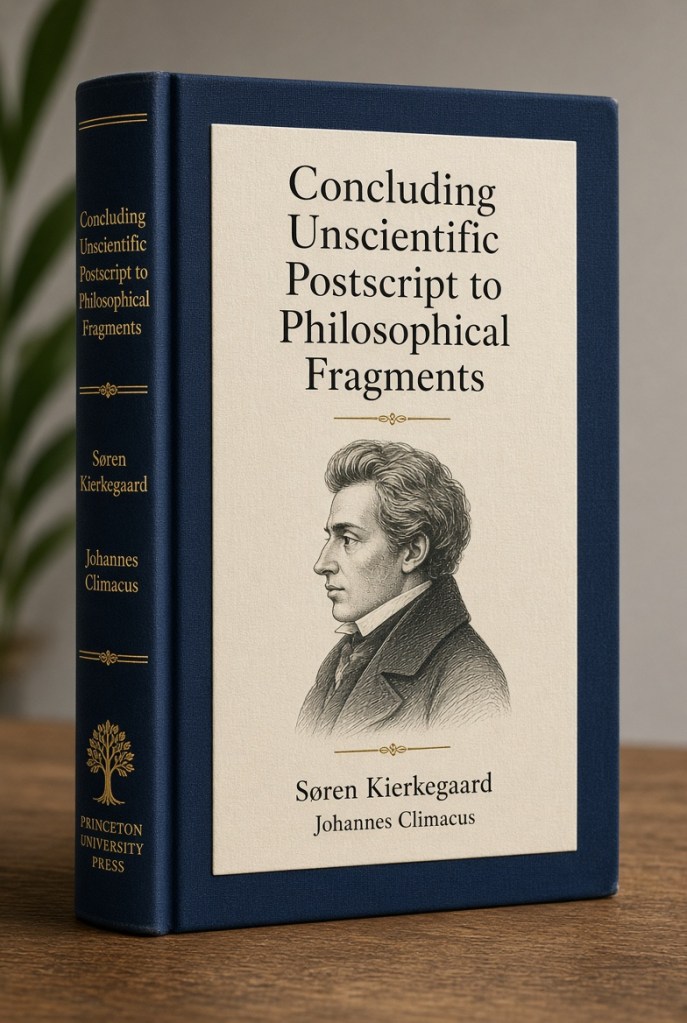
Early in the First Series, of Soren Kierkegaard’s Works of Love, September 29, 1847, analyzes the command “You shall love your neighbor as yourself” (Matthew 22:39). Every discourse, he notes, presupposes a starting-point. Here the presupposition is that “every person loves himself.” Christianity, unlike “high-flying thinkers,” does not begin without presuppositions, nor with a flattering one; it begins with this ordinary fact of self-love. One cannot love the neighbor rightly without learning to love oneself rightly, and the only one who can be loved more than oneself (with the truth of eternity) is God. The presupposition is thus both diagnostic (of improper self-love) and therapeutic: it opens the way for the “change of eternity.”
The key formulation in Kierkegaard’s Second Series, Works of Love is: “Love is to presuppose love; to have love is to presuppose love in others; to be loving is to presuppose that others are loving.” Love is not a quality one possesses in and for oneself (like wisdom); it is a relational orientation toward the other. Presuppositions are the condition for both the possibility and the performance of Christian love. Kierkegaard has presupposed faith in his Philosophical Fragments and with sin his Concept of Anxiety (both published in 1844) and love in his Works of Love.
The most distinctive and repeatedly emphasized use of presupposition appears in the discourse “Love Builds Up” (Second Series, Works of Love). Kierkegaard asks how one can build up love in another. Two possibilities exist: either one implants love in the other’s heart, or one presupposes that love is already there and, by that very presupposition, builds it up from the ground. Only God (who is love) can implant love. Therefore the work of love consists in presupposing its presence—however hidden—and “loving it forth.”

Works of Love centers on the quiet, non-preferential duty of neighbor-love: one person reaching toward another without drama or possession, set in an ordinary street rather than a romantic or heroic landscape. The mist and restrained light keep the focus on the simple, ongoing act of love rather than emotion.
Earthly building acts upon the object; spiritual building is primarily an action on the self—the act of constraining oneself to presuppose love rather than to judge, demand evidence, or attempt to produce it externally. The one who loves has nothing to point to as “my work,” because the work consists precisely in the presupposition itself. Once love appears, the lover must step aside and say, in effect, “I knew it was there all the time.”
Presupposition underwrites Kierkegaard’s “hermeneutics of charity.” In “Love Believes All Things—and Yet Is Never Deceived,” the lover interprets the other in the best possible light, furnishing mitigating explanations and refusing to hunt for faults. Love “hides a multitude of sins.”
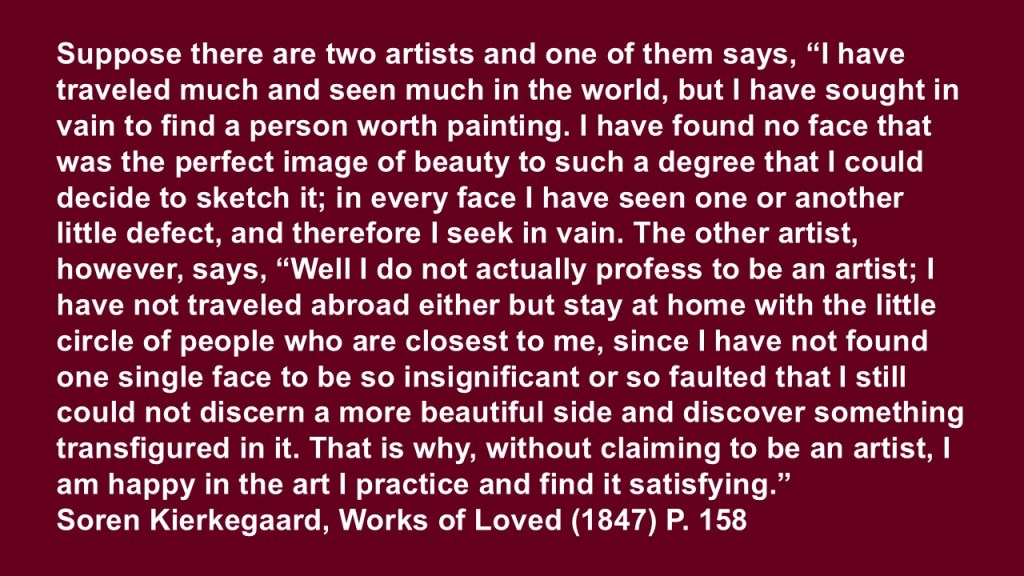
Presuppositions in Works of Love are the condition for both the possibility and the performance of Christian love. They begin with the unflattering fact of self-love, proceed by the divine command that transforms it, and culminate in the ongoing work of presupposing love in the other so that love may be built up from the ground God has already laid. Without these presuppositions, there is neither the command’s force nor the quiet, self-constraining labor by which love becomes recognizable in its fruits.
Kierkegaard’s use of presuppositions is strategic and anti-systematic. He takes the Christian dogma of hereditary sin as the orienting horizon, treats anxiety as its indispensable psychological presupposition (the dizziness of freedom that makes the qualitative leap possible without explaining or necessitating it), and rejects any framework—Hegelian, naturalistic, or purely psychological—that would reduce either freedom or the qualitative character of sin. This preserves both individual responsibility and the seriousness of the dogmatic problem without claiming that psychology can master what belongs to the single individual before God.


Jean-Paul Sartre and Kierkegaard.
Both treat anxiety (Angest / angoisse) as distinct from fear:
Where Kierkegaard keeps the dogma of hereditary sin constantly in mente and treats sin and freedom as self-presupposing, Sartre treats anxiety as the pure ontological revelation that nothing determines the for-itself. The religious “before God” is replaced by the absolute responsibility of the individual in a world without transcendent values. The qualitative leap into sin becomes the ongoing nihilation by which consciousness makes itself a lack of being. The educative path toward faith becomes the (often failed) struggle against bad faith.
Sartre uses Kierkegaard’s concept as a powerful phenomenological starting point—the lived experience of freedom as vertigo—but relocates it entirely within an atheistic ontology of consciousness as nothingness. The result is an anxiety that discloses the same abyss of possibility Kierkegaard described, yet without the possibility of a leap of faith that would redeem or ground it.
Sources: Made with Grok AI.
Philosophical Fragments, June 13, 1844- Originally published by Princeton University Press, Princeton, New Jersey in 1936. Translated by David F. Swenson. Translated by David F. Swenson, translation revised by Howard V. Hong. This material was prepared for Religion Online by Ted and Winnie Brock
The Concept of Anxiety: A Simple Psychologically Orienting Deliberation on the Dogmatic Issue of Hereditary Sin by Soren Kierkegaard June 17, 1844 Vigilius Haufniensis, Edited translated by Reidar Thomte Princeton University Press 1980
Works of Love, by Soren Kierkegaard, September 29, 1847, David Swenson 1946, Howard Hong and Edna Hong 1995, George Pattison 2009
Concluding Unscientific Postscript to Philosophical Fragments Feb 28, 1846 Hong translation

