Howard Hong said Søren Kierkegaard was one of the towering Christian existential thinkers of the mid-nineteenth century whose writings call for Christian morality: a defense of faith and religion (Introduction to Philosophical Fragments). Kierkegaard asked “the question in ignorance because he didn’t even know what could have led him to ask it” in his 1844 book Philosophical Fragments. What was the question? “How far does the Truth admit of being learned?” He referred to Socratic questions often in his many writings as he does here in PF. How is truth introduced to the individual? From within or from without? “For what a man knows he cannot seek, since he knows it; and what he does not know he cannot seek, since he does not even know for what to seek.” Kierkegaard is involved with questions of Truth, the Teacher, and the Disciple throughout his authorship.

Kierkegaard lived a short life. He was born May 5, 1813 and died November 11, 1855. He wrote the following in his Journals in 1835: “t will be easy for us once we receive the ball of yarn from Ariadne (love) and then go through all the mazes of the labyrinth (life) and kill the monster. But how many are there who plunge into life (the labyrinth) without taking that precaution?” He was always speaking to “my reader”, “my listener”, the “single individual” in his writings. He wants the one who will forsake the ball of yarn and plunge into the labyrinth. I recommend Kierkegaard’s book Philosophical Fragments as a book to begin with in studying his thoughts.


Two years after the publication of Philosophical Fragments the witty Kierkegaard published Concluding Unscientific Postscript to Philosophical Fragments. His first book was very short, the latter was over 600 pages and, according to Kierkegaard, took four years to write. “Rarely has a literary undertaking been so favored by fate as has my Philosophical Fragments. Doubtful and reticent as I am with regard to every private opinion and self-appraisal, I do without any doubt dare to say truthfully one thing concerning the fate of the little pamphlet: it has aroused no sensation, none whatever.” (CUP 1846, 1992 p. 5) “I now ask: How do I become a Christian? I ask solely for my own sake.” (617) He didn’t want to quantify himself into a qualitative decision. (96) The decision is about the subjectivity of truth rather than objective (scientific) truth. “Christianity has itself proclaimed itself to be the eternal essential truth that has come into existence in time; it has proclaimed itself as the paradox and has required the inwardness of faith with regard to what is an offense to the Jews, foolishness to the Greeks-and an absurdity to the understanding. It cannot be expressed more strongly that subjectivity is truth and that objectivity only thrusts away, precisely by virtue of the absurd, and it seems strange that Christianity should have come into the world in order to be explained, as if it were itself puzzled about itself and therefore came into the world to seek out the wise man, the speculative thinker, who can aid with the explanation. It cannot be expressed more inwardly that subjectivity is truth than when subjectivity is at first untruth, and yet subjectivity is truth. Suppose that Christianity was and wants to be a mystery, an utter mystery, not a theatrical mystery that is revealed in the fifth act, although the clever spectator already sees through it in the course of the exposition.” (213-214)


“There is a story about the inhabitants of Mols, that upon seeing a tree leaning over the water and prompted by the thought that the tree was thirsty, they resolved to help it. To that end, the first Molbo grabbed the tree, the next one grabbed his legs, and in this way, with the common purpose of helping the tree, they formed a chain-all on the presupposition that the first one would hold fast, because the first one was the presupposition. But what happens? Suddenly he lets go in order to spit on his hands so he can get an even better grip-and what then? Then all the Molboer fall into the water-and why? Because the presupposition was abandoned. To speculate within a presupposition in such a way that finally one also speculates the presupposition is exactly the same feat as to think, within a hypothetical “if”, something so evident that it acquires the power to transform into actuality the hypothesis within which it has its power.” (378)
“The systematic process promises everything and keeps nothing at all. In none of these three ways does the issue emerge, especially to in the systematic process. The system presupposes faith as given (a system that has no presuppositions!) Next it presupposes that faith should be interested in understanding itself in a way different from remaining in the passion of faith, which is a presupposition (a presupposition for a system that has no presuppositions!) and a presupposition insulting to faith, a presupposition that shows precisely that faith has never been given. The presupposition of the system-that faith is given-dissolves into a make-believe in which the system has made itself fancy that it knew what faith is.” (15)
“The task is to practice the absolute relation to the absolute end or goal, in such a way that the individual strives to reach this maximum: to relate himself simultaneously to his absolute end or goal and to the relative-not by mediating them but by relating himself absolutely to his absolute end or goal and relatively to the relative. The latter relation belongs to the world, the former to the individual himself and it is difficult simultaneously to relate oneself absolutely to the absolute end or goal and then at the same moment to participate like other human beings in one thing and another.” (47-408) “Just as in the great moment of resignation one does not mediate but chooses, now the task is to gain proficiency in repeating the impassioned choice and to express it in existence.” (410) Mediation looks fairly good on paper. “Revelation is marked by mystery, eternal happiness by suffering, the certitude of faith by uncertainty, easiness by difficulty, truth by absurdity; if this is not maintained, then the esthetic and the religious merge in common confusion. … The religious lies in the dialectic of inwardness deepening and therefore, with regard to the conception of God, this means that he himself is moved, is changed. An action in the eternal transforms the individual’s existence.” Notes p. 432
“What does the task look like in everyday life, for I continually have my favorite theme in mind: whether everything is indeed all right with the craving of our theocentric nineteenth century to go beyond Christianity, the craving to speculate, the craving for continued development, the craving for a new religion or for the abolition of Christianity. As for my own insignificant person, the reader will please recall that I am the one who finds the issue and the task so very difficult, which seems to suggest that I have not carried it out, I, who do not even pretend to be a Christian by going beyond it. But it is always something to point out that it is difficult, even if it is done, as it is here, only in an upbuilding divertissement, which is carried out essentially with the aid of a spy whom I have go out among people on weekdays, and with the support of a few dilettantes who against their will come to join in the game.” (466) “The highest His Imperial Highness is able to do, however, is to make the decision before God. The lowliest human being can also make his decision before God.” (497)


Soren Kierkegaard was a prolific author who was interested in introducing Christianity to people who thought they were Christians because they were born in Denmark (a Christian nation) and were baptized and attended Church (required by law). He wrote three books under the pseudonym Johannes Climacus (Johannes Climacus 1842, Philosophical Fragments 1844 and Concluding Unscientific Fragments to Philosophical Fragments 1846). I think he is a very important Christian author who deserves more attention from individuals other than philosophers and comedians.
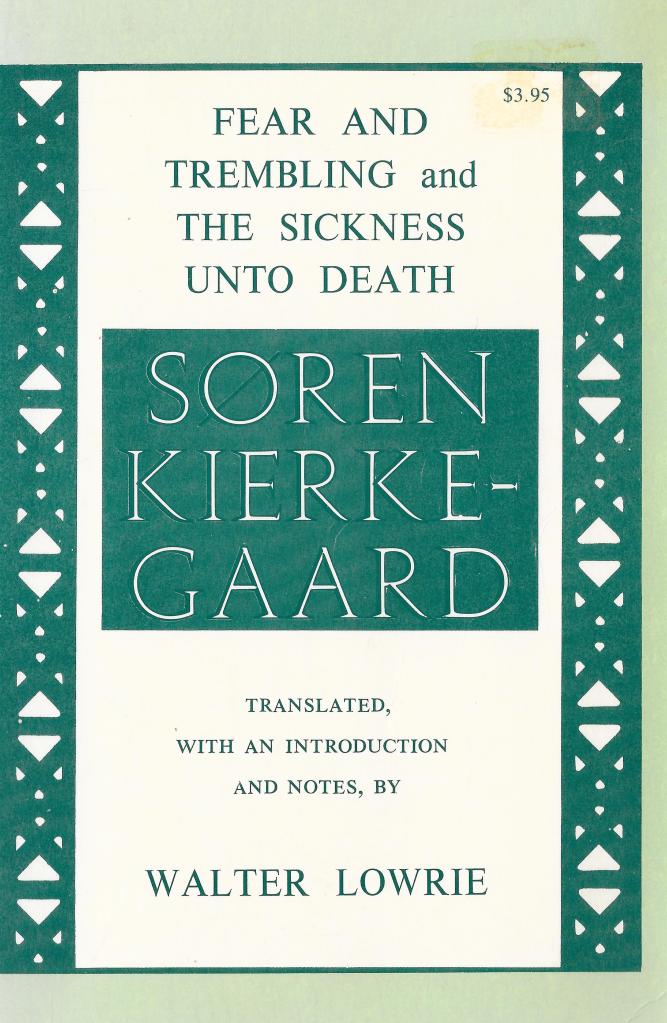
The Sickness unto Death (1849) explores the concept of the self. The self in despair over the self it is and the self grounded in the power that established it, the self before God. The self is always in the process of becoming so Kierkegaard says despair is good, as long as its over something rather than nothing. It was published under the pseudonym Anti-Climacus.
“Christian heroism is to risk unreservedly being oneself, an individual human being, this specific individual human being along before God, alone in this enormous exertion and this enormous accountability” “There is not a single human being who does not despair at least a little. In whose innermost being there does not dwell an uneasiness, an unquiet, a discordance, an anxiety in the fact of an unknown something, or a something he doesn’t even dare strike up acquaintance with, an anxiety about a possibility in life or an anxiety about himself.” “It is not lack of strength that makes a self lose itself in possibility. What is really missing is the strength to obey, to yield to the necessary in one’s self, what might be called one’s limits.”
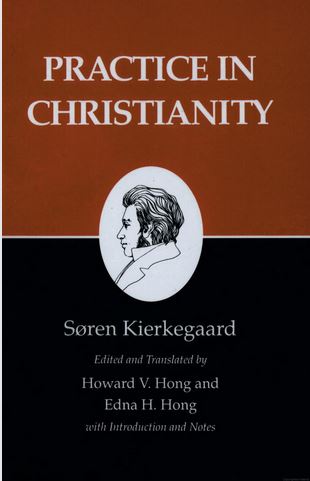
Kierkegaard published Practice (Training) in Christianity in 1850. This pseudonymous author was the opposite of Johannes Climacus. Johannes Climacus said he wasn’t a Christian but now Anti-Climacus is saying that he is an extraordinary Christian. The first part is concerned with one verse from the Bible: Come Here, All You Who Labor And Are Burdened, And I Will Give You Rest. Matthew 11.28.
“The invitation blasts away all distinctions in order to gather everybody together; it wants to make up for what happens as a result of distinction: the assigning to one person a place as a ruler over millions, in possession of all the goods of fortune, and to someone else a place out in the desert-and why, because he is wretched, because he needs help and compassion, and because human compassion is a miserable invention that is cruel.” “Whatever your error and sin, be it to human eyes more excusable and yet perhaps more terrible, or be it to human eyes more terrible and yet perhaps more excusable, be it disclosed here on earth or be it hidden and yet known in heaven-and even if you found forgiveness on earth but no peace within, or found no forgiveness because you did not seek it, or because you sought it in vain: oh, turn around and come here, here is rest!”
Johannes Climacus
Philosophical Fragments
Concluding Unscientific Postscript to Philosophical Fragments
The Sickness Unto Death
Training in Christianity
 Søren Kierkegaard: A Christian